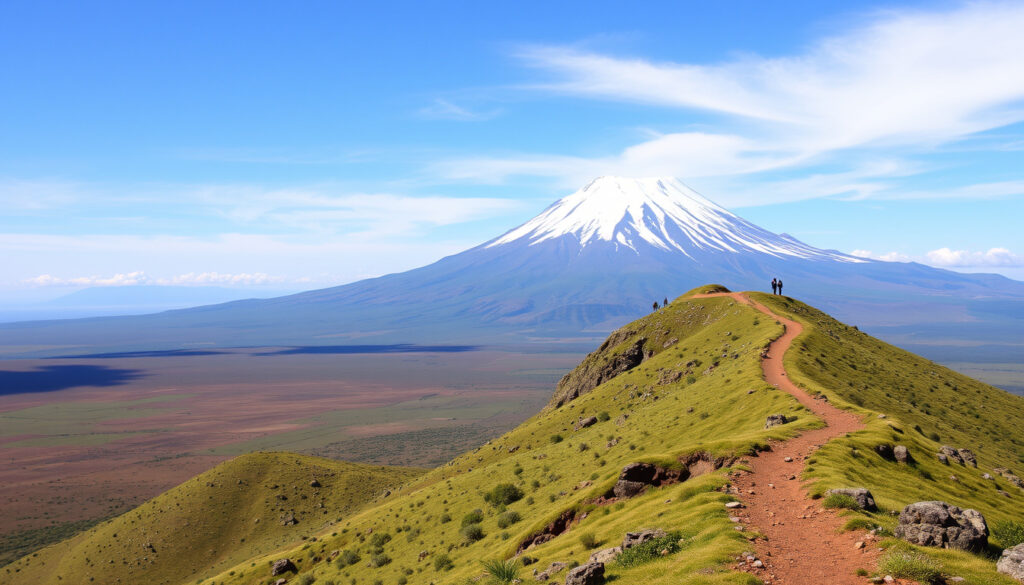
Kilimanjaro Mountain – All You Need to Know Before You Climb
Towering over the East African savannah, Mount Kilimanjaro is far more than a landmark. It is Africa’s highest point, the world’s tallest free-standing mountain, and one of the most iconic trekking destinations on the planet. Rising to 5,895 meters (19,341 feet) in northeastern Tanzania, this dormant stratovolcano attracts tens of thousands of climbers each year.
But for all its fame, many questions remain. Where exactly is it located? How difficult is the climb? Is it a volcano that could erupt again? This article presents the key facts to help anyone understand what Kilimanjaro truly is and what it takes to stand on its summit.
Where is Mount Kilimanjaro Located?
Tanzania, East Africa
5,895 m (19,341 ft)
Stratovolcano (Dormant)
5–9 Days
Mount Kilimanjaro sits within Kilimanjaro National Park in northeastern Tanzania, close to the border with Kenya. It is not part of any mountain range. As a free-standing peak, it rises directly from the surrounding plains, making its visual impact as dramatic as its elevation.
- Highest free-standing mountain in the world — Kilimanjaro is not connected to a mountain range; it rises alone from the plains.
- Permanent snow and glaciers at the equator — Despite its location near the equator, the summit is covered in ice year-round.
- No technical climbing required — Most standard routes are high-altitude treks, not technical climbs. Altitude acclimatization is the primary challenge.
- Seven main routes to the summit — The Marangu, Machame, Lemosho, Rongai, Umbwe, Northern Circuit, and Mweka (descent) routes offer varied experiences.
- Dormant stratovolcano with three cones — Kibo, Mawenzi, and Shira form the mountain’s massif. Only Kibo is considered dormant.
- Approximately 66% of climbers reach the summit — Altitude-related problems are the most common reason climbers turn back.
| Fact | Detail |
|---|---|
| Elevation | 5,895 m (19,341 ft) |
| Location | Kilimanjaro Region, Tanzania |
| First Ascent | 1889 by Hans Meyer and Ludwig Purtscheller |
| Mountain Range | None (Free-standing) |
| Prominence | 5,885 m (19,308 ft) – Ranked 4th in the world |
| Last Eruption | 160,000–200,000 years ago (estimated) |
Country and Continent
Mount Kilimanjaro is located entirely within the borders of Tanzania, a country in East Africa. It is one of the continent’s most recognizable geographic features and is often called the “Roof of Africa,” a term used by National Geographic in its general geographic overview of the mountain.
Proximity to Kenya
The mountain lies just a few kilometers south of the Kenyan border. Views of Kilimanjaro from the Amboseli plains in Kenya are among the most photographed in Africa. Despite its proximity to Kenya, the entire massif and all access points are on the Tanzanian side of the border.
Geographic Coordinates
Kilimanjaro’s summit, known as Uhuru Peak, is located at approximately 3°04′S latitude and 37°21′E longitude. These coordinates place the mountain well inside the tropics, yet its elevation creates a climate capable of sustaining permanent glaciers.
How Tall is Mount Kilimanjaro?
Height in Meters and Feet
The officially recognized height of Mount Kilimanjaro is 5,895 meters (19,341 feet) above sea level. This figure was confirmed by a new survey conducted in 2019. The summit is named Uhuru Peak, which means “Freedom Peak” in Swahili, and is located on the Kibo cone.
Comparison to Other Mountains
Kilimanjaro is the highest mountain in Africa, but comparisons with other peaks help put its stature in perspective. Mount Kenya, Africa’s second-highest mountain, stands at 5,199 meters — nearly 700 meters shorter. Among the Seven Summits (the highest peaks on each continent), Kilimanjaro ranks fourth in elevation but is widely considered the most accessible to trekkers without technical mountaineering experience.
Free-Standing vs. Range
One of Kilimanjaro’s most distinctive characteristics is that it is a free-standing mountain. Unlike peaks such as Everest, which rise as part of the Himalayan range, Kilimanjaro rises approximately 4,900 meters from its base on the surrounding plains. According to Guinness World Records, this makes it the world’s tallest free-standing mountain.
Because Kilimanjaro is not part of a range, trekkers gain nearly 5,000 meters of vertical elevation from base to summit. This rapid elevation gain is a key reason why altitude acclimatization is so critical compared to climbs in the Himalayas, where trekkers may spend weeks adjusting at intermediate elevations before reaching similar altitudes.
How Long Does It Take to Climb Mount Kilimanjaro?
Standard Route Durations (5–9 Days)
Climbing Kilimanjaro typically takes between 5 and 9 days, depending on the route chosen. Shorter itineraries, such as the Marangu Route (often called the “Coca-Cola Route”), can be completed in 5 to 6 days. Longer routes like the Lemosho or Northern Circuit require 7 to 9 days and are designed to improve acclimatization.
The climbing routes on Kilimanjaro listed by most official sources include Marangu, Machame, Rongai, Lemosho, Umbwe, and the Northern Circuit. Some references list five routes because the Mweka route is used primarily for descent rather than ascent. Live Science notes this distinction in its overview of the mountain.
Factors Affecting Climb Time (Acclimatization)
Acclimatization is the most important factor in determining climb duration. The mountain’s rapid gain in elevation makes altitude sickness a serious risk. Most experienced guides recommend choosing a longer route to allow the body more time to adjust. Altitude-related problems are the most common reason climbers turn back before reaching the summit.
Difficulty Level: Trek vs. Technical Climb
Kilimanjaro is a high-altitude trekking mountain, not a technical climbing peak for most standard routes. No ropes, crampons, or ice axes are required on the normal routes. However, the altitude, cold temperatures (which can drop to approximately -18°C or lower with wind chill at the summit), and cumulative fatigue make it a physically demanding challenge.
Is Kilimanjaro a Volcano or Dangerous?
Volcanic Status (Dormant, Not Extinct)
Mount Kilimanjaro is a dormant stratovolcano. Multiple authoritative sources, including the USGS Volcanic Hazards Program, classify it as dormant rather than extinct, meaning it could potentially erupt again. The mountain consists of three volcanic cones: Kibo, Mawenzi, and Shira. Kibo is the highest cone and is considered dormant, while Mawenzi and Shira are generally described as extinct.
A dormant volcano is one that has not erupted in recorded history but still shows signs of potential activity. Kibo, the cone that hosts Uhuru Peak, falls into this category. Mawenzi and Shira are considered extinct. The distinction is important for understanding the mountain’s geological stability.
Last Eruption History
The last major eruption from Kibo is estimated to have occurred approximately 360,000 years ago. One source notes that the last volcanic activity of any kind was about 200 years ago, though this is not universally agreed upon. Encyclopaedia Britannica describes the mountain’s volcanic history in its comprehensive entry on Kilimanjaro.
Safety Concerns: Altitude vs. Evil Myths
Some local folklore speaks of spirits inhabiting the mountain’s harsh upper reaches, and travelers occasionally search for information linking Kilimanjaro to supernatural dangers. These are cultural beliefs, not factual hazards. The real dangers are altitude sickness, cold exposure, and the physical demands of the trek.
Statistically, about 66% of climbers reach the summit. Altitude-related problems are the primary reason for failure. Proper route selection, paced ascent, and adequate preparation are the best safeguards.
Acute Mountain Sickness (AMS) can affect any climber regardless of fitness. Symptoms include headache, nausea, dizziness, and fatigue. Severe forms — HAPE and HACE — can be life-threatening. The only reliable treatment is descent. Kilimanjaro’s rapid elevation gain makes acclimatization the single most important safety factor on the mountain.
What Is the History of Mount Kilimanjaro?
- 1–3 Million Years Ago — Volcanic formation begins via tectonic activity in the East African Rift.
- 1848 — First recorded sighting by Europeans; German missionary Johannes Rebmann documents the snow-capped peak.
- 1889 — First successful summit by Hans Meyer (Germany) and Ludwig Purtscheller (Austria).
- 1912 — First detailed scientific mapping by German cartographers.
- 1973 — Designated as a National Park (Kilimanjaro National Park).
- 1987 — Declared a UNESCO World Heritage Site.
- 2019 — New survey conducted to calculate exact height (5,895 m).
The UNESCO World Heritage Centre officially notes that Kilimanjaro National Park “protects the highest mountain in Africa and the highest free-standing mountain in the world,” summarizing the site’s global significance.
What Is Known and What Remains Uncertain About Kilimanjaro?
What is clearly documented
- Mount Kilimanjaro is located in Tanzania.
- It is the highest mountain in Africa.
- It is a dormant volcano and has not erupted in recorded history.
- The summit elevation is 5,895 m (19,341 ft).
What remains open to question
- The exact rate of glacial melt on the summit remains under scientific monitoring; some models predict ice-free conditions by 2050.
- Some local myths attribute evil spirits to the mountain’s harsh conditions, but this is cultural and not factual.
- The exact date of the mountain’s last eruption is debated; most geologists agree it was at least 160,000 years ago.
Why Is Mount Kilimanjaro Important?
Mount Kilimanjaro stands as a global icon of natural wonder, adventure, and climatic diversity. Rising from the African savannah to a permanent snowcap, it encapsulates five distinct ecological zones. Its unique status as a free-standing peak makes it a bucket-list destination for trekkers of all levels, offering one of the highest successful summit rates among the Seven Summits.
The mountain also serves as a critical indicator of climate change. Its glaciers have been retreating rapidly over the last century, and ongoing scientific monitoring tracks the pace of this change. For local communities, particularly the Chagga people who have lived on its slopes for centuries, Kilimanjaro holds deep cultural and spiritual significance.
What Do Official Sources Say About Kilimanjaro?
“Kilimanjaro National Park protects the highest mountain in Africa and the highest free-standing mountain in the world.”
— UNESCO World Heritage Centre
“The mountain is known as the ‘Roof of Africa’ and is a dormant volcano with three cones.”
— National Geographic
Both Encyclopaedia Britannica and Wikipedia provide detailed encyclopedic coverage of Kilimanjaro’s geography, geology, and climbing history. These sources are regularly updated and are widely cited as authoritative references for the mountain’s physical characteristics.
Key Takeaways About Mount Kilimanjaro
Mount Kilimanjaro is the highest mountain in Africa at 5,895 meters, a free-standing dormant stratovolcano located in Tanzania. Most standard routes are high-altitude treks rather than technical climbs, and success depends heavily on route choice, acclimatization, and paced ascent. The summit target is Uhuru Peak on the Kibo cone. With approximately 66% of climbers reaching the top, preparation and respect for altitude are the deciding factors for anyone attempting this iconic peak.
Frequently Asked Questions
What are some interesting facts about Mount Kilimanjaro?
Mount Kilimanjaro is the tallest mountain in Africa at 5,895 meters. It is a free-standing dormant volcano located in Tanzania. It has three volcanic cones: Kibo, Mawenzi, and Shira. The first successful ascent was in 1889. Despite being near the equator, its summit has permanent glaciers.
Is Kilimanjaro evil?
No, Mount Kilimanjaro is not evil. This is a myth. Some local legends may speak of spirits inhabiting the mountain, but the mountain itself is a natural, inert geographic feature. The dangers are purely physical — altitude and weather — not supernatural.
Where can I find pictures of Mount Kilimanjaro?
High-quality images of Kilimanjaro are widely available through stock photography sites, travel blogs, and official tourism websites. The most iconic views include the snow-capped peak from the Amboseli plains in Kenya and the dramatic glacier fields near the summit.
Is Kilimanjaro erupting?
No. Mount Kilimanjaro is a dormant volcano and is not currently erupting. The last known activity was over 160,000 years ago. Some searches may confuse Kilimanjaro with active volcanoes in Ethiopia such as Erta Ale or Mount Nyiragongo, but there is no eruption at Kilimanjaro.
Is there a live webcam of Kilimanjaro?
Yes. Live webcams and weather stations are available on Kilimanjaro National Park’s official site and through specialized streaming services. These show real-time conditions at the summit and base camps.
Which is taller: Mount Kenya or Kilimanjaro?
Mount Kilimanjaro (5,895 m) is significantly higher than Mount Kenya (5,199 m). Both are among the highest mountains in Africa and are located in East Africa — Kenya and Tanzania, respectively.
More related posts
 Frodo Baggins – Biography, Actor, and Journey to Mount Doom
 Nick Cannon – Family, Net Worth, and Career Highlights
 Martin Short – Biography, Movies, Net Worth and Personal Life
 Klaudia Glam – Fatal Soho Accident and Murder Case
 Free Things to Do Near Me – Parks Museums Events Northern Virginia
 Claire Bloom – Biography, Relationships, and Net Worth
 Joseph Stalin – Biography, Height, Cause of Death and Key Facts
 Adam Ants – Real Name, Age, Net Worth and 2025 Tour
