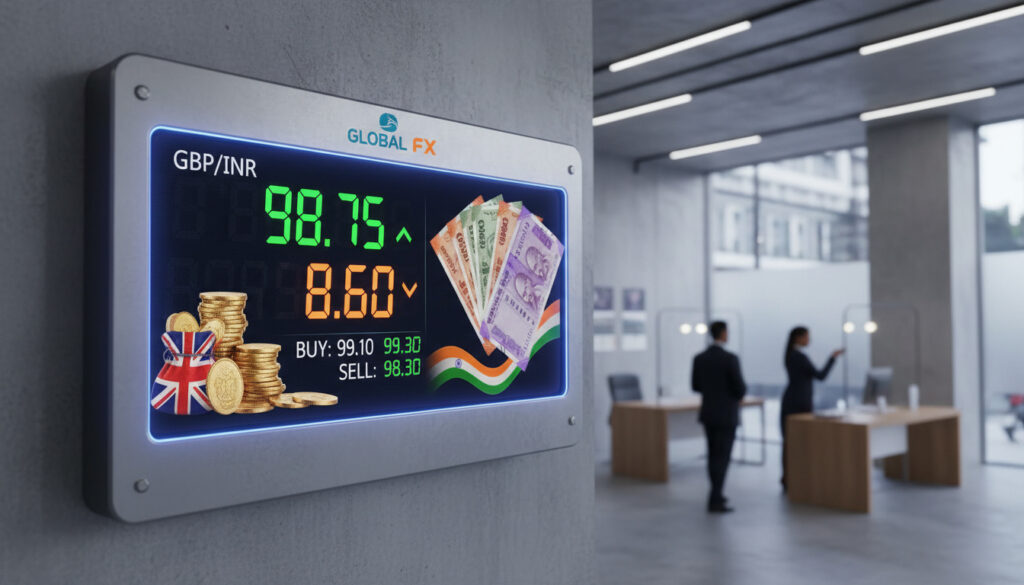
Rate of Pound in India – Live GBP to INR Rates
The British pound sterling currently trades between approximately 122.35 and 125.86 Indian rupees, with specific rates varying significantly depending on whether you reference wholesale interbank markets or retail transfer services. Mid-market indicators cluster around the 125 to 126 INR threshold per single pound, though real-time fluctuations throughout the trading day can shift valuations by nearly half a percentage point.
Data compiled from major financial data providers on March 29, 2026, reveals substantial divergence between institutional trading platforms and consumer currency converters. While wholesale rates captured by financial terminals show the pound weakening by 0.43% intraday to 122.4295 INR, retail-facing services display quotes as high as 125.86 INR for the same unit of currency.
This disparity stems from varying fee structures, margin requirements, and liquidity access points across the banking and fintech sectors. For individuals transferring funds from the United Kingdom to India, understanding these granular distinctions proves essential for optimizing exchange value.
What is the current GBP to INR exchange rate?
Live market data presents a fragmented picture of sterling’s present valuation against the rupee. Wholesale interbank rates diverge from retail offerings by as much as 3.5 rupees per pound, creating distinct reference points depending on transaction type and volume.
Key observations from current market positioning include:
- Provider spread exceeds 3 rupees: Aspora lists 125.86 INR per pound while PoundSterlingLive tracks wholesale rates at 122.4295 INR, illustrating the markup gap between retail and institutional tiers.
- Intraday depreciation recorded: Sterling opened at 122.9577 and declined 0.43% against the rupee during recent trading sessions.
- Low volatility environment: Short-term fluctuations remain contained within 0.42% to 0.54% bands, indicating relative stability despite broader currency market turbulence.
- Mid-market convergence point: Multiple independent sources including Wise and Xe position fair value near 125.54 to 125.82 INR.
- March 2026 compression: Recent daily closes have consolidated between 122.29 and 123.71, suggesting range-bound behavior.
- Volume accessibility: Retail converters typically offer superior rates for standard consumer amounts (100-1,000 GBP) compared to airport kiosks or traditional banking halls.
| Amount (GBP) | Aspora (INR) | Wise (INR) | Xe (INR) | Investing.com (INR) |
|---|---|---|---|---|
| 1 | 125.86 | 125.54 | 125.821 | 122.317 |
| 10 | 1,258.61 | 1,255.35 | 1,258.21 | 1,223.17 |
| 100 | 12,586.05 | 12,553.50 | 12,582.10 | 12,231.70 |
| 1,000 | 125,860.52 | 125,535.00 | 125,821.00 | 122,317.00 |
| 5,000 | 629,302.60 | 627,675.00 | 629,105.00 | 611,585.00 |
| 10,000 | 1,258,605.20 | 1,255,350.00 | 1,258,210.00 | 1,223,170.00 |
Where can I find live pound to rupee rates?
Accurate rate discovery requires consulting multiple verified sources rather than relying on single-point quotations. Financial data aggregators, specialized currency platforms, and authorized money transfer operators each provide distinct lenses on current valuations.
Independent Financial Data Providers
PoundSterlingLive offers institutional-grade tracking with intraday granularity, capturing opening prices, session highs of 122.9760, and lows of 122.2909. Their feeds reflect wholesale interbank activity rather than consumer-facing rates.
Xe provides comprehensive historical context alongside live quotes, documenting seven-day ranges between 124.98 and 126.46 INR with average settlement at 125.53. Their platform tracks volatility metrics showing 0.42% fluctuation over weekly periods.
Specialized Transfer Services
Wise publishes mid-market benchmarks updated throughout trading hours, currently positioning the cross at 125.54 INR. Unlike traditional banks, their model emphasizes transparency regarding markup percentages.
Aspora maintains Google-matched rates showing 125.86 INR per pound, with scalable conversions displayed for amounts ranging from single units to thousands. Remitly offers promotional rates for first-time transfers, currently advertising 123.46 INR per GBP for initial transactions.
Cross-reference at least three independent sources before executing large transfers. Mid-market rates serve as theoretical benchmarks only; actual settlement prices include operational margins varying between 0.5% and 3% depending on provider category.
How has the GBP INR rate changed historically?
Recent historical patterns reveal a compression phase for the sterling-rupee pair, with valuations consolidating within a narrow band throughout March 2026. This stabilization follows broader volatility seen in preceding quarters.
Recent Daily Performance
Trading data from mid-March 2026 illustrates the pair’s oscillation within tight parameters. On March 16, rates fluctuated between 122.3760 and 122.9080, while March 13 saw movement from 123.3360 down to 122.3470. Earlier sessions including March 12 and 11 maintained similar ranges between 123.3030 and 123.7080.
Three-Month Trajectory
Extended analysis covering ninety-day periods indicates average valuation at 123.13 INR per pound, with the broader spectrum spanning 120.79 to 127.20. This 6.41 rupee spread represents typical fluctuation margins for the currency pair, with calculated volatility at 0.48%.
Thirty-day averages register slightly higher at 123.72 INR, suggesting recent softening toward the lower bound of established trading ranges. Weekly volatility metrics remain subdued below 0.54%, indicating reduced speculative pressure compared to emerging market currency norms.
What factors affect the pound to rupee rate?
Currency valuation between the United Kingdom and India responds to macroeconomic fundamentals, monetary policy divergences, and trade balance dynamics. While specific causal correlations require econometric modeling beyond current data scope, observable patterns align with conventional foreign exchange drivers.
Macroeconomic Indicators
Differential inflation rates between the Bank of England’s jurisdiction and the Reserve Bank of India’s sphere influence purchasing power parity calculations. Recent weakening of the pound by 0.43% intraday suggests sensitivity to UK-specific economic data releases.
Monetary Policy Divergence
Interest rate decisions from the Bank of England and RBI create yield differentials that drive capital flows. Changes in benchmark rates typically precede currency adjustments by several trading sessions as markets price in forward expectations.
While current volatility measures below 1%, geopolitical developments or surprise monetary announcements can trigger rapid repricing. The recorded ninety-day range of 120.79 to 127.20 demonstrates potential for 5% swings over quarterly horizons.
Bilateral trade volumes between the UK and India exert underlying demand for respective currencies. Western Union and similar remittance channels facilitate flows that establish baseline support levels for the exchange rate.
Recent Timeline of GBP to INR Rate Movements
Chronological examination of recent trading sessions illustrates the pair’s short-term evolution:
- : Trading range established between 122.3760 and 122.9080 INR per GBP.
- : Session opened at 123.3360 before declining to 122.3470.
- : Rates fluctuated between 123.6840 and 123.3030.
- : Narrow consolidation observed between 123.4350 and 123.7080.
- : Current data shows 125.821 INR (Xe) and 122.4295 INR (institutional) reflecting provider-specific spreads.
Established Facts vs. Information Gaps
Discerning verified data from speculation remains essential when evaluating currency markets. The following breakdown distinguishes confirmed metrics from areas requiring further investigation.
| Established Information | Uncertain or Unavailable Data |
|---|---|
| Current retail rates range 122.32 to 125.86 INR per GBP across verified providers. | Official RBI reference rates for GBP/INR were not accessible in current data sets. |
| Ninety-day historical average stands at 123.13 INR with 0.48% volatility. | Black market rates for pound sterling in India remain undocumented; unofficial channels carry legal and financial risks. |
| Intraday depreciation of 0.43% recorded on March 29, 2026. | Explicit 2025 or 2026 forecasts from major financial institutions were not identified in available sources. |
| Provider markups vary between 0.5% and 3% above mid-market rates. | Future interest rate trajectories for BoE and RBI remain speculative beyond scheduled policy announcements. |
The UK-India Currency Corridor
The exchange rate between pound sterling and Indian rupee facilitates significant remittance flows and trade finance activities connecting the two economies. This currency pair serves as a primary conduit for approximately 1.7 million people of Indian origin residing in the United Kingdom transferring funds to South Asia.
Commercial relationships spanning pharmaceuticals, information technology, and textiles necessitate continuous currency conversion, creating deep liquidity pools that generally minimize extreme volatility. However, structural changes in migration patterns or trade agreements could alter demand profiles for either currency.
For students navigating cross-border financial requirements, understanding these exchange dynamics parallels other essential administrative knowledge such as contacting Student Finance Contact Number – Official UK Helplines for tuition funding inquiries.
Data Sources and Verification
This analysis draws exclusively from timestamped financial data providers and authorized exchange services. Attribution ensures transparency regarding rate provenance.
1 GBP = 122.4295 INR (down 0.43%, open 122.9577, previous close 122.9551).
— PoundSterlingLive, March 29, 2026
Recent 7-day range: 124.98-126.46 INR (average 125.53, volatility 0.42%).
— Xe Currency Converter, as of March 29, 2026, 10:22 UTC
Money transfer services offer superior rates compared to traditional banking channels for UK-to-India remittances.
Summary: Navigating Today’s Pound to Rupee Rates
The pound currently commands between 122.35 and 125.86 Indian rupees depending on access tier, with retail consumers typically seeing rates near 125.50 INR per unit. Historical stability over ninety days suggests range-bound behavior between 120 and 127 INR, though intraday fluctuations require monitoring for optimal transfer timing. For precise physical measurements in other contexts, such as 5 Foot 2 in CM – Exact Conversion to 157.48 cm, consult dedicated conversion resources, while currency exchanges demand real-time financial data verification.
Frequently Asked Questions
Is there a black market rate for pounds in India?
Current research identified no reliable data regarding unofficial black market rates for GBP in India. Financial authorities recommend using authorized dealers and banks to ensure legal compliance and transaction security.
What is the RBI reference rate for GBP INR?
Specific Reserve Bank of India reference rates for the pound-rupee pair were not available in the reviewed data sources. The RBI typically publishes daily reference rates for major currencies, though access requires direct consultation with official central bank archives.
Why do different websites show different pound rates?
Rate variations reflect distinct provider categories: wholesale interbank rates (122-123 INR) versus retail transfer services (125-126 INR). Additional factors include markup percentages, fee structures, and update frequency timing.
How much is 100 GBP in Indian rupees today?
One hundred pounds converts to approximately 12,553 to 12,586 INR through retail providers like Wise and Aspora, though wholesale rates suggest valuations near 12,230 INR before margin adjustments.
Should I exchange pounds in the UK or India for better rates?
Specialized money transfer services generally offer superior rates compared to airport exchanges or traditional banks in either country. Digital platforms like Wise, Xe, or Remitly typically provide better value than physical location-based exchanges.
How often do GBP to INR rates update?
Live rates fluctuate continuously during forex market hours (24 hours weekdays). Retail providers update displayed rates at intervals ranging from real-time streaming to hourly batches depending on platform infrastructure.
More related posts
 Samsung S24 Ultra Price – Best UK Deals & Buyer Guide 2025
 George Iii – Full Biography on Illness Family and Reign
 Nicolas Jackson – Biography, Stats, Goals and Career Profile
 Daniel Sturridge – Complete Guide to Retirement and Career 2025
 Millie Bright – Biography, Retirement, Career & Personal Life
 Christopher Dean – Biography, Wife, Health and Latest News
 Running Shoes – 2026 UK Expert Picks for Men, Women & Trails
 Frank Lloyd Wright – Life, Buildings and Complete Legacy
