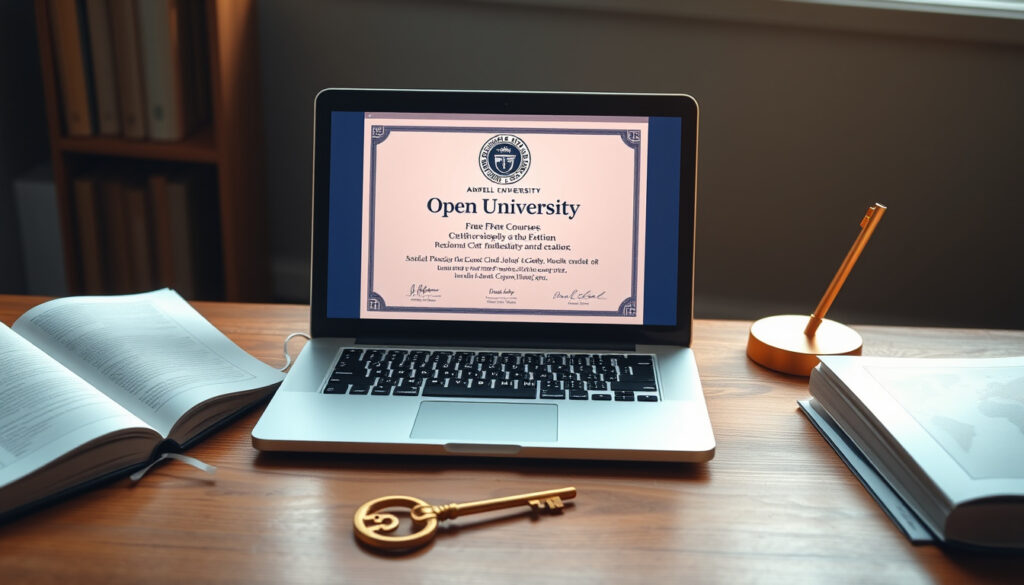
Open University Free Courses – Recognition, Certificates and Access Guide
The Open University operates OpenLearn, a platform offering more than 900 free short courses drawn directly from OU academic materials. These self-paced courses span eight subject areas and include both casual learning options and structured Badged Open Courses with digital credentials. Understanding what recognition these certificates carry, how account creation works, and which subject-specific pathways exist helps prospective learners make informed decisions about their educational options.
OpenLearn serves as the university’s open educational resources gateway, providing university-quality content without tuition fees. The platform attracts diverse learners, from those exploring new subjects to professionals seeking skill development. Course availability, certificate types, and subject variety represent key factors for anyone considering this learning pathway.
Are Open University Free Courses Recognised?
What Recognition Do Certificates Carry?
Completing most OpenLearn courses earns a free Statement of Participation, available as a downloadable PDF from the course rewards section within 24 hours of completion. This statement confirms engagement with OU-authored material and remains shareable on professional platforms including LinkedIn and resumes.
Badged Open Courses represent a separate credential category. Over 66 Badged Open Courses exist on the platform, each requiring approximately 24 hours of study and passage through all assessments. These award an OU-branded digital badge demonstrating professional development commitment, sharable across social media and eportfolios.
Badges and Statements of Participation are not formally recognised academic credits or accredited qualifications. They demonstrate interest, professional development, or study commitment rather than formal degree equivalence.
Do Employers Value These Credentials?
Research indicates that over half of OU students use OpenLearn courses to build confidence before committing to full modules or to inform their choice of degree pathway. Employers may value these credentials as evidence of continuous professional development and proactive learning initiative, though they represent continuing education rather than formal qualifications.
Key Facts About OpenLearn Credentials
- Statements of Participation come as free downloadable PDFs, shareable on LinkedIn and professional resumes
- Digital badges from Badged Open Courses prove study commitment and professional development interest
- Course badges require approximately 24 hours of study and passing all section assessments
- Formal accreditation through academic credits does not accompany these free offerings
- Professional value lies in demonstrating continuous learning to prospective employers
- LinkedIn integration allows direct sharing of achievements to professional profiles
Quick Reference Facts
| Attribute | Details |
|---|---|
| Platform | OpenLearn |
| Total Free Courses | 900+ short courses |
| Cost | Completely free |
| Statement Format | Downloadable PDF |
| Badge Availability | 66+ Badged Open Courses |
| Badge Study Time | Approximately 24 hours each |
| Formal Credits | Not included with free access |
How to Access Open University Free Courses Login?
OpenLearn courses remain immediately accessible without payment or account creation. Visitors can browse the full catalogue and begin learning in seconds. However, creating a free OpenLearn profile unlocks additional functionality including progress tracking, favourite saving, and achievement access.
Creating Your OpenLearn Account
New users navigate to sign in through the OU website and select the “create account” option. The registration process requires an email address confirmation before full access activates. Once confirmed, users return to sign in using their chosen username and password combination.
Existing Open University students and staff use their standard OU credentials to access OpenLearn directly. The unified login system means one set of credentials serves both formal OU studies and OpenLearn’s free offerings.
Creating a profile enables progress saving across sessions, bookmarking favourite courses, and accessing Statement of Participation downloads from the course rewards section after completing enrolled courses.
Navigating the Course Catalogue
The subject information page organises courses across eight major categories including science, maths and technology, money and business, psychology, and law. Users filter by subject area, skills for study or work, or keywords to locate relevant content efficiently.
Courses operate entirely self-paced with no enrollment deadlines. This flexibility allows learners to progress according to personal schedules without pressure from fixed start dates or completion windows.
Open University Free Courses for Over 60s
OpenLearn maintains universal accessibility for all adult learners regardless of age. No specific benefits, discounts, or tailored pathways exist exclusively for users aged 60 and above. All content remains freely available without payment or eligibility restrictions.
This universal approach means learners over 60 access identical course materials, certificates, and learning tools as younger participants. The absence of age-specific programming reflects OpenLearn’s mission to provide open education to everyone.
While no age-specific benefits exist, the self-paced nature of OpenLearn courses particularly suits learners seeking flexible, pressure-free educational exploration at any stage of life.
Best Open University Free Courses in AI, Law, and Psychology
The OpenLearn catalogue spans diverse academic disciplines with courses produced by OU academics. Subject-specific pathways enable focused study in areas including artificial intelligence, legal competencies, and psychological principles.
Open University Free Courses AI
AI-related offerings include courses such as “Systems Thinking in Practice,” which examines approaches to understanding complex systems including technological and organisational contexts. These courses provide foundational perspectives on artificial intelligence applications without requiring technical backgrounds.
Open University Free Courses Law
Law-oriented courses explore topics including related professional competencies and legal frameworks. These offerings suit individuals interested in understanding legal principles, regulatory environments, or career transitions into legal-adjacent fields.
Open University Free Courses Psychology
Psychology courses cover subjects ranging from team-based collaboration to human behaviour understanding. The “Working in Teams” Badged Open Course demonstrates how psychology principles apply directly to professional environments, earning a recognised badge upon completion.
Featured Badged Courses
- Working in Teams — badged course enhancing employability through evidence-based team dynamics
- Human Resource Management and EDI — professional skills covering equality, diversity, and inclusion practices
- Systems Thinking in Practice — AI-adjacent approaches to complex system understanding
- Professional Skills Extracts — language and competency development modules
Additional Subject Areas
Beyond AI, law, and psychology, the catalogue includes courses in science and technology, money and business, languages, education, and history. The university’s official OpenLearn page provides access to the complete listing with filtering options.
OpenLearn Platform Evolution
The OpenLearn platform has developed significantly since its inception, expanding from initial course offerings to a comprehensive educational resource serving hundreds of thousands of learners annually.
- 2006 Launch — OpenLearn established as The Open University’s open educational resources initiative
- Course Expansion — gradual growth to over 900 free courses across multiple disciplines
- Badged Open Courses Introduction — addition of 66+ badged programmes requiring approximately 24 hours each
- Subject Catalogue Development — organisation into eight filterable subject categories
- Statement and Badge Integration — linking achievements to LinkedIn and professional platforms
What Is Certain and What Remains Unclear
Established Information
- 900+ free courses available via OpenLearn
- Free Statement of Participation upon course completion
- 66+ Badged Open Courses requiring ~24 hours each
- OU-branded digital badges awarded for badged courses
- All content produced by OU academics
- No login required for basic course access
- Courses organised across eight subject categories
- Statements downloadable within 24 hours of completion
Information Requiring Clarification
- Whether formal accreditation pathways exist for specific courses
- Specific recognition policies from individual employers
- Which courses may count toward formal OU degree modules
- Updates to badge offerings since last catalogue review
- Course retirement or addition schedules
Understanding OpenLearn’s Position in Online Education
OpenLearn occupies a distinctive position among online learning platforms. Unlike commercial alternatives, it operates as an extension of The Open University, carrying institutional credibility and academic oversight. Course content derives directly from OU curriculum, ensuring alignment with formal educational standards.
The platform’s primary mission extends beyond skill development to democratising access to university-level knowledge. This approach benefits lifelong learners, career changers, and curious individuals seeking structured educational content without financial barriers.
Sources and Further Information
The information presented draws from official Open University sources including the OpenLearn platform and university websites. Direct statements from these authoritative sources establish facts about course availability, certificate types, and platform functionality.
For the most current course listings and availability, users should consult OpenLearn’s official course listings directly. Badge availability and specific course content may vary as the platform continues development.
Summary: Key Takeaways About Open University Free Courses
OpenLearn provides over 900 free courses from The Open University’s academic programme, accessible without payment or formal admission requirements. While certificates and digital badges carry professional value demonstrating continuous learning, they do not constitute formal academic credits or accredited qualifications. Learners over 60 access identical resources as all other users, with no age-specific benefits or programmes available. Subject-specific pathways exist across AI, law, psychology, and additional disciplines, with badged courses requiring approximately 24 hours of study. Getting started involves simply visiting the platform, creating an optional profile, and beginning exploration of available subjects.
For those exploring financial support options for formal education, checking available resources through the Student Finance Contact Number – Official UK Helplines provides official guidance on funding possibilities.
Frequently Asked Questions
Do The Open University free courses come with certificates?
Completing courses earns a free Statement of Participation available as a downloadable PDF. Badged Open Courses additionally award OU-branded digital badges. Neither constitutes formal academic credit.
Are there special Open University free courses for over 60s?
No age-specific courses or benefits exist. All OpenLearn content remains universally accessible and free for adult learners regardless of age.
What AI-related courses does OpenLearn offer?
AI-adjacent offerings include “Systems Thinking in Practice,” examining approaches to complex system understanding in technological contexts.
Can I study law through OpenLearn free courses?
Law-related courses cover professional competencies and legal frameworks. These suit learners interested in legal principles and regulatory environments.
What psychology courses are available on OpenLearn?
Psychology courses include team dynamics, human behaviour, and professional applications. The badged “Working in Teams” course demonstrates psychology in workplace contexts.
Do I need to create an account to access courses?
Basic access requires no login. Creating a free OpenLearn profile enables progress tracking, saving favourites, and downloading Statements of Participation.
How long do Badged Open Courses take to complete?
Each Badged Open Course requires approximately 24 hours of study, including passing all sections and assessments to earn the digital badge.
More related posts
 Centara Mirage Beach Resort Dubai – Guest Reviews and Family Guide
 Road Bike – Complete Guide for UK Beginners 2025
 Car Garage Near Me – Find Local UK Services And Dealers
 Bella Hull – Age, Tour, Wikipedia and Personal Life 2025
 Benjamin Zephaniah – Biography, Cause of Death and Legacy
 Jake Bugg – Age, Net Worth, Wife and Tour 2025
 Aree Gearhart – Age, Children, and Relationship with Jack Osbourne
 Desire Doue – Age, Stats, PSG Career and Transfer Rumors
