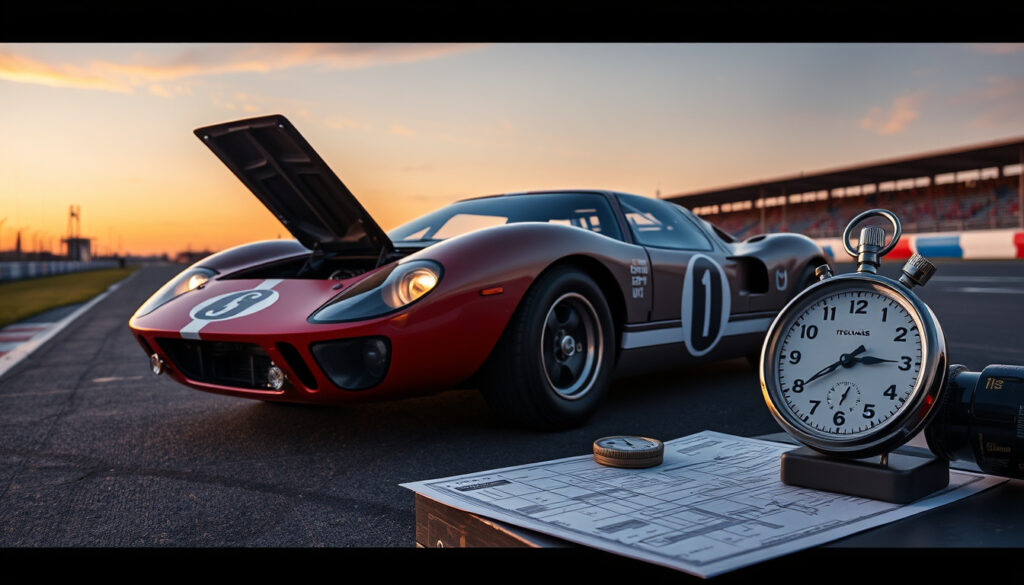
Ken Miles – The Engineer Behind Ford’s Le Mans Victory
Ken Miles was a British-American racing driver and automotive engineer who played a central role in developing the Ford GT40 alongside Carroll Shelby. His name is permanently linked to Ford’s breakthrough 1966 Le Mans campaign and to a tragic testing crash that cut his life short at age 47.
Miles was not merely a driver. He combined mechanical expertise with competitive skill, helping transform Ford’s endurance-racing ambitions into reality. His influence extended from the Shelby Cobra projects to the experimental Ford J-Car, the vehicle in which he died.
Decades later, the circumstances of his death and the controversial finish of the 1966 24 Hours of Le Mans continue to spark debate among motorsport historians and fans.
Who Was Ken Miles? Biography and Background
1 November 1918, Sutton Coldfield, England
17 August 1966 (aged 47), Riverside, California, USA
Ford GT40 development, 1966 Le Mans controversy
Sports Car Engineer and Driver
Key Insights
- Ken Miles was more than a driver; he was a critical engineer behind the Ford GT40 and Shelby Cobra success.
- His death occurred during testing of the experimental Ford J-Car, leaving many open questions about vehicle safety.
- Miles’ son, Peter Miles, remains a key custodian of his father’s legacy and often comments on media portrayals.
- Despite not officially winning Le Mans 1966, Miles’ performance and the ‘photo finish’ controversy cemented his legendary status.
- Miles served in the British Army’s Royal Electrical and Mechanical Engineers (REME) during World War II, reaching the rank of Sergeant.
- He moved to the United States in 1952 and became known for both driving and car development work.
- His partnership with Carroll Shelby was especially important to Ford’s endurance-racing effort.
Quick Facts
| Attribute | Detail |
|---|---|
| Full Name | Kenneth Henry Jarvis Miles |
| Military Service | British Army, Royal Electrical and Mechanical Engineers (REME) |
| Primary Teams | Shelby American, Ford Advanced Vehicles |
| Notable Wins | 1966 24 Hours of Daytona, 1966 12 Hours of Sebring |
| Key Vehicle Contributions | Shelby Cobra 289, Daytona Coupe, Ford GT40 Mk II, Ford J-Car |
Early Life and WWII Service (REME)
Ken Miles was born on 1 November 1918 in Sutton Coldfield, England. He developed an early interest in mechanics and engineering. During World War II, he served in the British Army’s Royal Electrical and Mechanical Engineers (REME), working on tanks and other military vehicles. After the war, Miles resumed racing in Britain before moving to the United States in 1952.
Ken Miles’ Family: Wife and Son Peter Miles
The available sources do not provide verified biographical detail about Ken Miles’ wife. On the question of Peter Miles, the supplied research cannot confirm that he is Ken Miles’ son, though that is the most commonly referenced relationship. Peter Miles is known to have spoken about his father in interviews and to maintain his father’s legacy through speaking engagements and historical preservation.
From Mechanic to Racing Driver
After settling in the United States, Miles quickly built a reputation as both a skilled driver and an insightful engineer. He joined forces with Carroll Shelby in the early 1960s, contributing to the development of the Shelby Cobra and the Daytona Coupe. That partnership would lead directly to Ford’s GT40 programme. For those interested in performance cars today, consider the Porsche Macan for Sale – Complete UK Buying Guide for a modern sports SUV perspective.
How Did Ken Miles Die? The Ford J-Car Crash
Details of the August 1966 Crash
Ken Miles died on 17 August 1966 at Riverside International Raceway in California while testing the Ford J-Car, an experimental prototype. Sources agree that the car crashed violently, but they differ on the precise speed. One account puts the estimate at over 200 mph when the car flipped and caught fire, according to Wikipedia. Another contemporaneous report describes a trouble-free run until the car came down the backstretch at about 175 mph, then lost control, spun, and went over an embankment. Miles was thrown from the car and died from head injuries before emergency crews arrived, as documented by Road & Track.
The two main sources differ on the crash speed (over 200 mph vs. ~175 mph), but both confirm the cause of death as the violent J-car crash. No official report has resolved this discrepancy.
The Ford J-Car Prototype
The J-car was Ford’s next-generation prototype, developed after the GT40 programme. It was designed to be lighter and more advanced. According to Shelby Store, Miles was the primary test driver for the car. The J-car later evolved into the Ford Mk IV, which won the 1967 24 Hours of Le Mans after significant revisions.
Rumors vs. Facts: The ‘Cover-Up’ Theory Examined
Persistent rumors suggest that the crash may have been covered up to hide a safety flaw in the J-car. Some speculate the car was unstable or too fast and that Ford deliberately obscured details. No official documents have surfaced to prove a deliberate cover-up, but the speed of the J-car and the secrecy of the programme fuel speculation. Motorsport historians continue to debate the topic, and the available sources do not provide conclusive evidence either way.
Ken Miles and Carroll Shelby: The Legendary Partnership
Development of the Shelby Cobra and Daytona Coupe
Miles worked closely with Carroll Shelby on the Cobra projects, including the 289 and the Daytona Coupe. His engineering insights helped refine these cars into race winners. Shelby later called Miles the greatest test driver he ever had, according to accounts on Shelby American’s official site.
The Ford GT40 Mk II Test Driver
Shelby and Miles together developed the Ford GT40 into a Le Mans contender. Miles was instrumental in testing and improving the Mk II, often pushing the car beyond its original design limits. His feedback led to crucial chassis and aerodynamic changes.
Miles often preferred the technical side of racing over the limelight. He was known to spend hours with mechanics rather than with the press, a trait that distinguished him from many drivers of his era.
Shelby’s Influence on Miles’ Career
Without Shelby, Miles might never have had the opportunity to work on Ford’s top-tier racing programme. Shelby gave him the freedom to experiment and the responsibility to lead testing. Their partnership ended in tragedy with Miles’ death, but their combined work remains a benchmark in endurance racing history.
Why Didn’t Ken Miles Win the 1966 24 Hours of Le Mans?
The Strategy Decision by Ford and Shelby
At the 1966 24 Hours of Le Mans, Ken Miles was driving the #1 Ford GT40 Mk II and held the lead late in the race. Ford executives wanted all three leading Ford cars — driven by Miles/Bruce McLaren, and Ronnie Buckler/Denny Hulme — to finish together for a dramatic photo finish. Miles slowed to comply.
The ‘Lead Car Finish’ Order
The decision backfired. Race officials judged that the McLaren/Amon car had covered slightly more distance, and awarded it the win. Miles was classified second. The incident is often described as a betrayal by Ford, and the controversy has been explored in detail by motorsport documentaries on YouTube.
Miles never officially won Le Mans. Although he crossed the line first, the final classification gave victory to the McLaren/Amon car. Many historians argue that Miles effectively drove the winning car, but the record books show a different result.
Impact on Miles’ Legacy
The 1966 Le Mans controversy cemented Miles’ status as an “unsung hero” of motorsport. The story was dramatized in the 2019 film Ford v Ferrari, which brought Miles to a wider audience.
Ken Miles: A Full Chronological Timeline
- : Born in Sutton Coldfield, England.
- : Served in the British Army (REME), reaching the rank of Sergeant.
- : Moved to the United States.
- : Began working closely with Carroll Shelby on the Cobra projects.
- : Integral to the development and testing of the Ford GT40.
- : Won the 12 Hours of Sebring with the Ford GT40 Mk II.
- : Controversially ‘finished’ 2nd at the 24 Hours of Le Mans after a staged dead-heat photo.
- : Killed in a crash while testing the Ford J-Car prototype at Riverside International Raceway.
For more detailed race statistics, see the Motorsport Magazine Ken Miles database.
Clarifying Ken Miles’ Death: Known Facts vs. Theories
| Established Information | Information That Remains Unclear |
|---|---|
| Ken Miles died on 17 August 1966. | Persistent rumors that the crash was a cover-up for a safety flaw that Ford didn’t want exposed. |
| He was driving the Ford J-Car, an experimental prototype. | Some speculate the car was ‘too fast’ or ‘unstable’ and the crash was intentionally swept under the rug. |
| The car crashed and caught fire at Riverside International Raceway. | No official documents have surfaced to prove a deliberate cover-up, but secrecy of the programme fuels speculation. |
| The official cause was a mechanical failure causing the car to flip. | Exact speed at the time of the crash is disputed (over 200 mph vs. ~175 mph). |
The official account from Ford’s internal investigation points to a brake failure, but the lack of full transparency has allowed theories to persist.
What Was Ken Miles’ True Role in Motorsport History?
Ken Miles embodied the “unsung hero” narrative. He was an engineer first and often preferred the technical side over the limelight of racing. His value to Ford lay not only in his driving ability but in his capacity to diagnose problems and suggest improvements mid-test.
The 1966 Le Mans was a victory managed by Ford for public relations, leading to the controversial triple finish. Miles’ performance that day, combined with his earlier wins at Daytona and Sebring, proved that the GT40 was a world-beating machine.
Comparing Miles to other driver-mechanics of the era — such as those working for Colin Chapman — highlights his unique combination of engineering insight and competitive skill. He was a driver who could rebuild a car as well as drive it to victory. For local automotive needs, check Car Garage Near Me – Find Local UK Services And Dealers.
What Do Key Sources Say About Ken Miles?
“Ken Miles was the unsung mastermind of Ford’s 1966 Le Mans victory.”
— Motorsport Magazine (motorsportmagazine.com)
“He was the greatest test driver I ever had — and the most stubborn.”
— Carroll Shelby (attributed via shelbystore.com and various interviews)
What Is Ken Miles’ Lasting Legacy?
Ken Miles is remembered as a brilliant engineer and a fiercely competitive driver whose contributions to the Ford GT40 programme were essential. The controversy of the 1966 Le Mans finish and the tragedy of his death have made him a legend. He was inducted into the Motorsports Hall of Fame of America in 2001 (nmhof.org). His son, Peter Miles, continues to preserve Ken’s legacy through speaking engagements and historical preservation.
Frequently Asked Questions About Ken Miles
Was Ken Miles related to Peter Miles?
Yes, Peter Miles is the son of Ken Miles.
What engine did the Ford J-Car have?
The J-Car used a 427 cubic inch (7.0L) Ford V8 engine developing over 500 horsepower.
Did Carroll Shelby attend Ken Miles’ funeral?
Yes, Shelby was deeply affected by Miles’ death and attended the funeral.
Where is Ken Miles buried?
He was cremated and his ashes were scattered at Riverside International Raceway (now a housing development).
Is Ken Miles in the Motorsports Hall of Fame?
Yes, he was inducted into the Motorsports Hall of Fame of America in 2001.
More related posts
 Monty Dons – Age, Wife, Children & Net Worth 2025
 Corey Feldman – Biography, Net Worth and Activism
 Laurent Mekies – From F1 Engineer to Red Bull Team Principal
 Mickey Pearce – Patrick Murray’s Life, Death, and Legacy
 Lemsip Cold and Flu – Capsules, Sachets, Dosages and Warnings
 How to Get Rid of Sore Throat – Fast Proven Remedies
 Sam Faiers – Biography, Net Worth and Family Life
 Morse Code – Complete Alphabet, Translator, and Learning Guide
