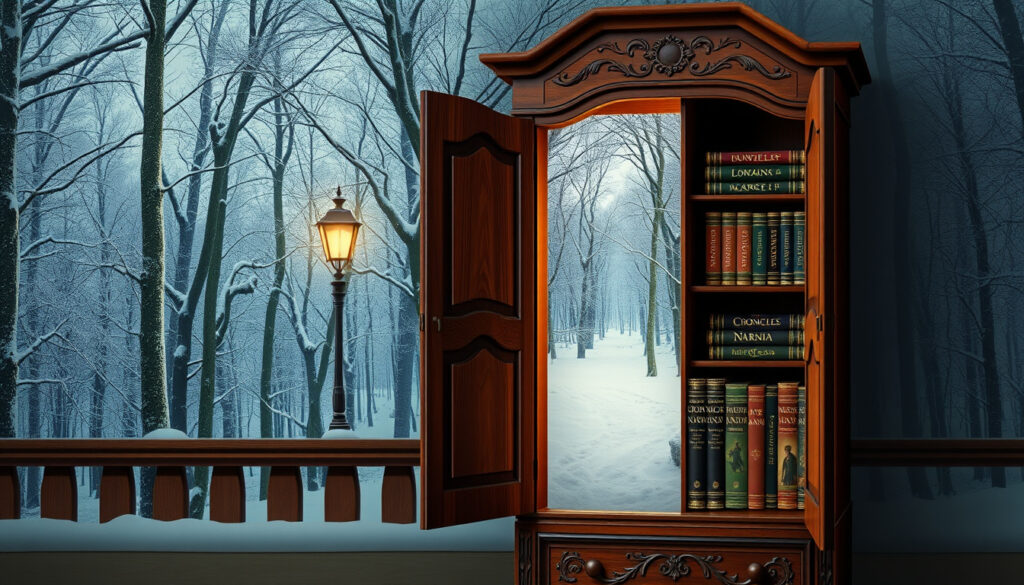
The Chronicles of Narnia – Books, Reading Order, Movies Guide
What Is The Chronicles of Narnia?
The Chronicles of Narnia stands as one of the most influential fantasy series in English literature. Written by C.S. Lewis between 1939 and 1954, the seven-book collection follows children who discover and enter the magical world of Narnia, a realm populated by talking animals, mythical creatures, and governed by the noble lion Aslan.
Lewis, an Irish novelist, poet, and academic, created the series while teaching at Oxford University. The books were originally published without numbering by Geoffrey Bles in the UK between 1950 and 1956. Pauline Baynes illustrated all seven volumes, bringing visual consistency to Lewis’s imaginative universe.
The series has been translated into more than 40 languages and continues to captivate readers across generations. Its blend of adventure, allegory, and moral instruction has secured its place as a cornerstone of children’s literature.
Key Facts About the Series
- All seven books feature children as protagonists entering Narnia through various portals, including wardrobes, paintings, and magical rings
- Aslan, the lion who created and rules Narnia, serves as the moral and spiritual center of the series
- The books were released annually without numbering, meaning the original cover designs gave no indication of intended reading sequence
- Each book functions as a standalone narrative while contributing to the broader mythology of Narnia
- Lewis completed writing all seven books before the series finished publishing, with The Lion, the Witch and the Wardrobe written first in 1949
- Douglas Gresham, Lewis’s stepson, has overseen publications and adaptations since Lewis’s death in 1963
The Seven Books at a Glance
| Book | Publication Year | Chronological Position |
|---|---|---|
| The Lion, the Witch and the Wardrobe | 1950 | 2nd |
| Prince Caspian: The Return to Narnia | 1951 | 4th |
| The Voyage of the Dawn Treader | 1952 | 5th |
| The Silver Chair | 1953 | 6th |
| The Horse and His Boy | 1954 | 3rd |
| The Magician’s Nephew | 1955 | 1st |
| The Last Battle | 1956 | 7th |
What Is the Correct Order to Read the Narnia Books?
Two competing reading orders have shaped how generations of readers experience The Chronicles of Narnia. The publication order, established when Geoffrey Bles released the books annually from 1950, was the standard sequence until 1994. Chronological order, following events within Narnia’s internal timeline, was adopted by HarperCollins that year based on correspondence between Lewis and a young reader.
Publication Order: The Original Sequence
Following publication order means reading the books as the world first encountered them. This approach captures Lewis’s evolving creative vision and allows readers to experience the series as a gradual revelation rather than a predetermined sequence.
According to The Gospel Coalition, Lewis never formally designated an official reading order during his lifetime. The books were released without numbering, and early publishers like Macmillan simply arranged them as they appeared. This means readers for decades encountered The Magician’s Nephew only after finishing The Last Battle.
- The Lion, the Witch and the Wardrobe (1950)
- Prince Caspian (1951)
- The Voyage of the Dawn Treader (1952)
- The Silver Chair (1953)
- The Horse and His Boy (1954)
- The Magician’s Nephew (1955)
- The Last Battle (1956)
The Magician’s Nephew reveals the origin story of Narnia itself. Reading it first would diminish the sense of discovery that Lewis originally intended, as the Pevensie children first encounter a fully established world rather than witnessing its creation.
Chronological Order: Following Narnian Time
The chronological sequence arranges books according to events within Narnia’s history. This order places The Magician’s Nephew first because it narrates the world’s creation and the wardrobe’s origin. The Wardrobe Door blog explains that HarperCollins adopted this approach following a 1957 letter from Lewis indicating he believed The Magician’s Nephew should come first, though he acknowledged both orders were valid.
- The Magician’s Nephew (Narnian Year 1)
- The Lion, the Witch and the Wardrobe (Narnian Years 1000–1015)
- The Horse and His Boy (Narnian Year 1014)
- Prince Caspian (Narnian Year 2303)
- The Voyage of the Dawn Treader (Narnian Years 2306–2307)
- The Silver Chair (Narnian Year 2356)
- The Last Battle (Narnian Year 2555)
Which Order Should New Readers Choose?
For first-time readers, publication order remains the recommended approach. This respects how Lewis crafted the stories and preserves narrative surprises that chronological reading would eliminate. The debate between these two sequences has generated extensive discussion among literary scholars and fans alike, with valid arguments supporting each perspective.
According to Wikipedia, Lewis never mandated a single reading order. His stepson Douglas Gresham and HarperCollins later championed chronological order, but Lewis himself stated that readers could choose whichever sequence appealed to them.
Is The Chronicles of Narnia Based on Christianity?
Christian allegory pervades The Chronicles of Narnia, though Lewis crafted his stories as adventures rather than explicit religious instruction. The series draws heavily from Lewis’s Christian worldview, weaving themes of sacrifice, redemption, and the triumph of good over evil throughout its narrative fabric.
Aslan as a Christ Figure
The lion Aslan represents the most significant Christian parallel in the series. Like Christ, Aslan is a sacrificial figure who willingly gives his life to save others. In The Lion, the Witch and the Wardrobe, Aslan allows himself to be killed on the Stone Table to save Edmund, accepting death as the price for redemption.
His subsequent resurrection mirrors the Christian account of Easter. The Gospel Coalition notes that Lewis intended these parallels to resonate with readers familiar with biblical narratives while remaining accessible to those encountering them for the first time.
Lewis drew inspiration from Christian symbolism but created original characters and plots. Aslan embodies Christ-like qualities without being a direct copy, and Narnia functions as a separate mythological world rather than an explicit biblical allegory.
Thematic Elements Throughout the Series
Beyond the central Aslan narrative, the books explore various Christian virtues and moral lessons:
- Temptation: Edmund’s betrayal in The Lion, the Witch and the Wardrobe reflects themes of temptation and forgiveness
- Courage: Characters repeatedly face overwhelming odds through faith and determination
- Providence: Divine guidance appears through signs, dreams, and unexpected interventions
- Faith over Despair: Characters triumph by maintaining hope even when circumstances seem hopeless
- The Fall: The Last Battle explores betrayal and the corruption of faith
- Salvation History: The arc of Narnia from creation through destruction mirrors biblical narrative structure
Lewis’s Intentions and Literary Approach
Lewis wrote the Narnia books partly as a way to share Christian truths with young readers in an engaging, imaginative form. His academic work in medieval and Renaissance literature influenced his approach to creating a coherent mythological world. The allegorical elements emerged naturally from his faith rather than from a predetermined theological blueprint.
The balance between entertainment and moral instruction has contributed to the series enduring appeal. Parents and educators have appreciated the books for introducing ethical concepts, while readers of all ages engage with the stories as pure fantasy adventures.
What Are the Chronicles of Narnia Movies and Adaptations?
The Chronicles of Narnia has inspired multiple screen adaptations over the decades, bringing Lewis’s magical world to television and cinema audiences worldwide.
BBC Television Series (1988–1990)
The BBC produced a acclaimed television adaptation between 1988 and 1990, covering all seven books. This series became the standard visual representation of Narnia for a generation of viewers and remains well-regarded for its faithfulness to the source material and impressive production values for the era.
Walden Media and Disney Films
Walden Media partnered with Disney to produce three feature films between 2005 and 2010:
- The Chronicles of Narnia: The Lion, the Witch and the Wardrobe (2005)
- The Chronicles of Narnia: Prince Caspian (2008)
- The Chronicles of Narnia: The Voyage of the Dawn Treader (2010)
These productions brought the series to mainstream audiences with significant marketing budgets and theatrical releases. The films achieved commercial success while sparking discussions about adaptation choices and fidelity to Lewis’s text.
Television Reboot Possibilities
Reports have emerged periodically about potential new television adaptations that could cover the remaining books not yet adapted to screen. These projects remain unconfirmed, and audiences await official announcements regarding future plans.
How Did C.S. Lewis Develop the Narnia Stories?
The origins of The Chronicles of Narnia date to 1939, when Lewis first imagined a faun carrying parcels through snowy woods. This image came to him during World War II, and he began developing the concept into a full narrative after conversations with his friend J.R.R. Tolkien at Oxford’s Eagle and Child pub.
Inspirations and Influences
Lewis drew from multiple sources when creating his fictional world:
- Mythology: Classical and Norse myths influenced the creature designs and naming conventions
- Medieval Literature: Knights, quests, and courtly elements reflect Lewis’s academic specialization
- Childhood Experiences: Wartime evacuations of children shaped themes of displacement and finding belonging
- Faith: Christian theology provided the moral and spiritual framework
The combination of these elements created a unique world that feels both familiar and distinctly original.
Publication History Timeline
Understanding when each book entered the world helps contextualize the reading order debate:
- 1950: The Lion, the Witch and the Wardrobe launches the series
- 1951: Prince Caspian continues the Pevensie children’s adventures
- 1952: The Voyage of the Dawn Treader expands the geographical scope
- 1953: The Silver Chair introduces new characters as protagonists
- 1954: The Horse and His Boy reveals events concurrent with The Lion, the Witch and the Wardrobe
- 1955: The Magician’s Nephew tells Narnia’s creation story
- 1956: The Last Battle concludes the series with an apocalyptic vision
The series remained in print continuously following its completion, with new editions and formats ensuring accessibility to successive generations of readers.
What Is Established Versus Unclear About the Series?
| Established Information | Remaining Questions |
|---|---|
| Seven canonical books exist | Whether Lewis preferred one reading order over another remains debated |
| All books written between 1949 and 1954 | The extent of editorial changes in various editions |
| C.S. Lewis was the sole author | Details about proposed but unwritten eighth book |
| Pauline Baynes illustrated all editions | Precise timeline for planned television adaptations |
| Series has sold millions of copies worldwide | Complete list of adaptation rights and options |
| Douglas Gresham oversees the estate | Long-term preservation plans for manuscripts |
Who Was C.S. Lewis and Why Did He Write Narnia?
Clive Staples Lewis (1898–1963) was an Irish novelist, scholar, and Christian apologist. His academic career at Oxford and Cambridge spanned medieval and Renaissance literature, providing the scholarly foundation that influenced his imaginative writing.
Lewis converted to Christianity in 1931, and his faith profoundly shaped his creative output. He wrote The Chronicles of Narnia during a period of personal happiness that followed his marriage to Joy Davidman in 1956. The series emerged from his love of fairy tales, mythology, and his desire to communicate spiritual truths through accessible narratives.
Alongside The Chronicles of Narnia, Lewis authored The Space Trilogy, The Screwtape Letters, and numerous theological works. His friendship with J.R.R. Tolkien and participation in the Inklings literary group influenced his approach to fantasy writing.
What Do Scholars and Critics Say About the Series?
“Lewis does not aim at allegory. There is no suggestion that Narnia is heaven or that the White Witch is the devil. Aslan is not God in a lion suit. The books work on a different level altogether. They are more like what the Middle Ages called ‘types’ — in which a historical event or person is also a sign of a spiritual truth.”
Literary critics have analyzed The Chronicles of Narnia through various lenses, examining its Christian symbolism, its place in children’s literature, and its narrative structure. Scholars at institutions including Oxford and Cambridge have produced extensive commentary on Lewis’s techniques and intentions.
The ThriftBooks collection notes highlight how the series influenced subsequent fantasy literature while maintaining its distinctive character as a children’s series with adult depth.
How to Approach Reading the Narnia Books Today
The Chronicles of Narnia remains accessible to contemporary readers despite being written decades ago. The books target middle-grade readers (ages 8–12) but contain layers of meaning that reward adult readers revisiting the series.
Whether following publication or chronological order, readers should approach the books as original adventures first, with allegorical significance emerging naturally from the narrative rather than imposed upon it. The Miracle on 34th Street principle applies here: the magic of Narnia works on its own terms before any deeper analysis begins.
Families reading together may find value in discussing themes as they arise rather than introducing theological context immediately. This approach preserves the sense of discovery that has made the series endure across generations.
Frequently Asked Questions
Is The Chronicles of Narnia a true story?
No, The Chronicles of Narnia is a fictional fantasy series. While it contains Christian allegorical elements, the events and characters are products of C.S. Lewis’s imagination rather than historical events or accounts.
What is the last book in The Chronicles of Narnia?
The Last Battle (published in 1956) serves as the series conclusion, depicting Narnia’s final days and the afterlife awaiting its characters.
What age are the Narnia books appropriate for?
The books are marketed for middle-grade readers (ages 8–12) but are frequently enjoyed by older readers and adults. Parents may wish to preview The Last Battle due to its emotional intensity.
Did C.S. Lewis write an eighth Narnia book?
Lewis reportedly considered additional books but never completed one. Various notes and proposals have surfaced regarding potential stories that were never developed into finished manuscripts.
How does The Horse and His Boy fit into the timeline?
The Horse and His Boy occurs during the same period as The Lion, the Witch and the Wardrobe (Narnian Year 1014), following Shasta’s journey through Calormen while the Pevensie children rule Narnia.
Are there more Narnia adaptations planned?
Reports have surfaced about potential television adaptations covering the remaining unproduced books, but no official announcements confirm specific projects or timelines.
Why does The Magician’s Nephew have a different number than other editions?
Different publishers have arranged the books differently. Macmillan originally published without numbering, while HarperCollins editions adopted numbering for chronological reading after 1994.
More related posts
 Lyse Doucet – Age, Career, Partner, Accent & More
 Arthur Tv – Real Name, Age, and Background
 Senne Lammens – Biography, Stats, Injury, Age and Height
 Richard Lionheart – The crusader king’s true story
 Gustav Klimt – Biography, Paintings and The Kiss
 Cast of the Wheel of Time (TV Series) – Full List by Season
 Jimmy Connors – Net Worth, Wife, Age, and Career in 2025
 Sam Worthington – Biography, Movies, Net Worth, and Family Life
