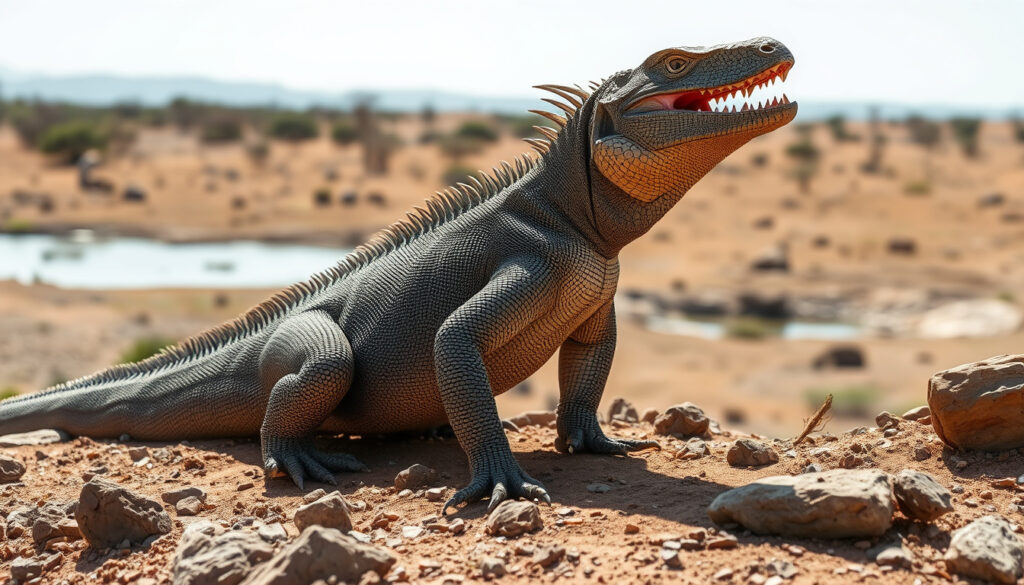
Komodo Dragon – Size, Venom, Speed and Key Facts
The Komodo dragon, native to a handful of Indonesian islands, holds the title of the world’s largest living lizard. Known locally as ora or “land crocodile,” this apex predator can reach impressive sizes, possesses a venomous bite, and exhibits powerful ambush hunting tactics. Its reputation as a formidable creature is well-earned, but its status as an endangered species highlights a fragile existence.
These giant reptiles, often called “dragons” due to their size and ferocity, are native to Indonesia. They are apex predators that dominate their ecosystems, but their limited habitat places them in a precarious position. Understanding their true nature requires a look at verified facts, from their physical dimensions to their unique biological adaptations.
How Big Is a Komodo Dragon? (Size, Weight, and Length)
The size of a Komodo dragon is its most distinguishing feature, driving much of the public’s curiosity. Adult males average between 8 and 9 feet (2.4 to 2.7 meters) in length, while females are typically smaller, reaching about 6 feet (1.8 meters). The largest verified captive specimen measured 3.13 meters (10.13 feet) long.
Komodo Dragon Facts at a Glance
- Scientific name: Varanus komodoensis
- Average length: up to 3 meters (10 feet)
- Average weight: up to 150 kg (330 lb)
- Speed: up to 20 km/h (12 mph)
- Lifespan: 30+ years in wild
- Diet: Carnivore (deer, carrion)
- Venom: Yes, with anticoagulant effects
- Status: Endangered
Key Insights
- Komodo dragons are the largest living lizards; their size is a key curiosity driver.
- Their venomous bite is a specialized adaptation, not merely a bacterial infection.
- They share a common ancestry with monitor lizards, but are distinct in size and venom system.
- Despite their formidable nature, they are endangered with fewer than 2,500 mature individuals remaining.
- Pet ownership is illegal in most countries and highly dangerous due to their size and predatory behavior.
Key Measurements and Facts
| Attribute | Detail |
|---|---|
| Length | Up to 3 meters (10 feet) |
| Weight | Up to 150 kg (330 lb) |
| Top Speed | 20 km/h (12 mph) |
| Lifespan | 30+ years in wild |
| Venom | Yes, contains toxins that prevent blood clotting |
| Conservation Status | Endangered (IUCN) |
| Native Range | Komodo, Rinca, Flores, Gili Motang (Indonesia) |
Is Komodo Dragon Venom Dangerous to Humans?
Scientific studies have confirmed that Komodo dragons possess venom glands in their jaws. These glands produce toxins that work to lower blood pressure, thin the blood, and prevent clotting. The effects of the venom can send prey into shock, a critical adaptation that aids in hunting. The bacteria found in their saliva, while numerous, is now understood to play a secondary role to the venom itself.
Proteins in the Komodo dragon’s venom inhibit blood clotting, induce muscle paralysis, and can cause hypothermia, potentially leading to unconsciousness in envenomated animals.
The danger to humans is significant. A bite from a Komodo dragon can cause severe wounds, blood loss, and the rapid onset of shock due to the venom’s effects. While attacks on humans are rare, they can be fatal. The animal’s thick skin, strong claws, and sharp serrated teeth that resemble shark jaws make it a highly dangerous adversary.
How does Komodo dragon venom work?
The venom’s primary function is to incapacitate prey rapidly. By preventing blood from clotting and inducing muscle paralysis, the dragon can bite a large animal and then simply follow it until it collapses. This strategy allows them to hunt animals much larger than themselves, such as water buffalo. The venom’s effectiveness has been a key factor in their success as apex predators.
Komodo Dragon vs Monitor Lizard: What Are the Key Differences?
Komodo dragons are a type of monitor lizard, but they are distinct in several key ways. While all Komodo dragons are monitor lizards, not all monitor lizards are Komodo dragons. The most obvious difference is size: the Komodo dragon is the largest living lizard species, far surpassing other monitors in both length and weight.
Other monitor lizards, such as the water monitor or the crocodile monitor, are formidable predators in their own right, but they lack the Komodo dragon’s specialized venom system and sheer mass. The Komodo dragon’s unique island evolution has driven gigantism and a venomous bite, features not seen in most other monitor species.
How Fast Can a Komodo Dragon Run? (Speed and Hunting Behavior)
Despite their bulky size, Komodo dragons can achieve surprising bursts of speed. They can run up to 12–13 mph (19–20 km/h) for short distances. This speed, combined with their ambush hunting style, makes them effective predators. They lie camouflaged in bushes or tall grasses for hours, waiting for prey to approach.
While a fit human can reach higher top speeds, a Komodo dragon is agile and can change direction quickly. The safest strategy is to maintain a significant distance and avoid any close encounters. They are also capable swimmers, able to cross ocean currents up to 3 miles.
Once a Komodo dragon bites its prey, it releases and then calmly follows the wounded animal for miles, using its keen sense of smell to locate the corpse. Their diet primarily consists of Javan rusa deer, feral pigs, water buffalo, and carrion. In some cases, up to 10% of their diet can be younger Komodo dragons, a behavior known as cannibalism. They can consume up to 80% of their body weight in a single meal.
Can You Keep a Komodo Dragon as a Pet? (Legality and Care)
Keeping a Komodo dragon as a pet is not a realistic or legal option for private individuals. They are an endangered species protected by Indonesian law and international treaties (CITES). These regulations prohibit the trade and private ownership of the animals. Zoos and accredited conservation facilities are the only entities permitted to house them.
The practical challenges are immense. A Komodo dragon requires a vast, specialized enclosure that mimics its tropical habitat, a carefully controlled diet of large prey, and expert veterinary care. The danger they pose to humans, combined with their complex needs, makes them entirely unsuitable for private ownership. Their conservation status also means that every individual in captivity plays a role in the species’ survival.
How Long Do Komodo Dragons Live? (Lifespan, Teeth, and Early Life)
In the wild, Komodo dragons have a lifespan of up to 30 years, though some estimates suggest they can live up to 62 years. Their teeth are sharp, serrated, and constantly replaced. This adaptation ensures they always have a functional set of cutting tools for tearing flesh and consuming large prey.
Why do baby Komodo dragons live in trees?
Hatchlings are born greenish with yellow and black bands, providing excellent camouflage in the forest canopy. They take to the trees for the first eight months of their lives. This arboreal lifestyle is a critical survival strategy, protecting them from adult Komodo dragons and other predators. They mature slowly, not reaching full adulthood until they are 8–11 years old. Females lay between 20 and 30 eggs and guard them for several months. Remarkably, they can also reproduce without mating through a process called parthenogenesis.
History and Discovery of Komodo Dragons
The Komodo dragon was unknown to Western science until the early 20th century, though it was well known to local populations. The story of its discovery is a fascinating chapter in natural history.
- 1910: First Western documentation by Lieutenant van Steyn van Hensbroek.
- 1912: Officially described by Peter Ouwens.
- 1926: W. Douglas Burden’s expedition brought specimens to AMNH, sparking global interest.
- 1980: Komodo National Park established to protect the species.
- 2020: Genetic studies clarify venom vs bacteria debate (venom confirmed).
Certainty vs Uncertainty: Key Debates
| Established Information | Information That Remains Unclear |
|---|---|
| Bite infection vs venom: Confirmed that venom glands exist and cause significant physiological effects; bacteria may play a secondary role. | Maximum size: Historical claims of 4m+ individuals exist, but verified records show up to 3.13 meters (10.3 feet). |
| Population numbers: Estimates vary, but IUCN lists under 2,500 mature individuals. | Some local populations may be stable, but overall numbers are uncertain due to survey challenges. |
Background and Conservation Context
The Komodo dragon’s isolated island evolution has led to gigantism and a unique venom system, making it a prime example of island biogeography. As an apex predator, it plays a crucial role in regulating prey populations within its ecosystem. Conservation threats include habitat loss, poaching, and the ever-present risk of natural disasters such as volcanic activity and tsunamis. In media and pop culture, they are often conflated with larger monitor lizards, but taxonomic evidence clearly separates them as a distinct species with unique evolutionary traits.
Sources and Key Quotes
“It is the largest extant species of lizard, growing to a maximum length of 3 m (10 ft) and weighing up to 150 kg (330 lb).”
— Wikipedia
“Thanks to their thick skin, strong claws, sharp teeth, and painful bite, Komodo dragons are NOT an animal you’d want to mess with.”
— National Zoo (Smithsonian)
“The Komodo dragon is the largest living lizard species in the world.”
— Britannica
Summary: What You Need to Know About Komodo Dragons
The Komodo dragon is an extraordinary and endangered reptile, notable for its immense size, powerful venom, and specialized hunting behavior. Found only on five Indonesian islands, it faces significant conservation challenges. For more detailed information, you can explore the Komodo Dragon – Endangered Species Profile.
Frequently Asked Questions
How sharp are Komodo dragon teeth?
Komodo dragon teeth are sharp, serrated, and resemble shark jaws. They are constantly replaced throughout the animal’s life to maintain optimal cutting ability.
What do Komodo dragons eat?
Their diet primarily consists of Javan rusa deer, feral pigs, water buffalo, and carrion. They are known to consume up to 80% of their body weight in a single meal.
Where do Komodo dragons live?
They are found only on five islands in Indonesia’s Komodo National Park: Komodo, Rinca, Gili Motang, Padar, and western Flores.
Are Komodo dragons dangerous to humans?
Yes. They are powerful predators with a venomous bite and sharp teeth. While attacks are rare, they can be fatal.
Why do baby Komodo dragons live in trees?
Hatchlings spend their first eight months in trees to avoid predators, including adult Komodo dragons. Their greenish color with bands provides camouflage.
More related posts
 Julianne Moore – Age, Husband, Movies and 2026 Updates
 Hole in the Wall – BBC Game Show History and Revival
 Check If a Car Is Taxed – Official DVLA Guide
 Josh Windass – Biography, Career, Family and Wrexham Move
 Jacob Fortune-Lloyd – Height, Age, Family and Filmography
 Carol Vorderman – Age, Net Worth, Partner and 2025 Update
 5ft 2 in cm – Precise Conversion to 157.48 Centimeters
 Scarlett Johansson – Biography, Net Worth, Husband and Career Guide
