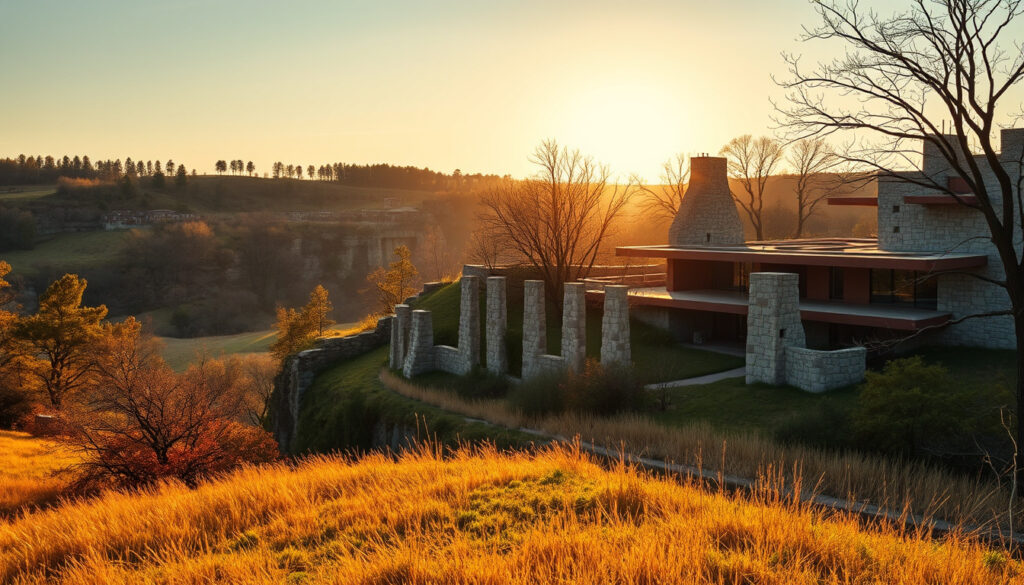
Frank Lloyd Wright – Life, Buildings and Complete Legacy
Frank Lloyd Wright reshaped the way Americans live and build. Over a career that spanned seven decades, he designed more than 1,100 structures, of which 532 were realized, and pioneered a philosophy known as organic architecture — the belief that a building should exist in harmony with its inhabitants and its natural surroundings. The American Institute of Architects has called him the “greatest American architect of all time.”
Wright’s influence extends far beyond the walls of his famous buildings. From the cantilevered terraces of Fallingwater to the spiraling ramp of the Guggenheim Museum, his work challenged every convention of 19th-century design. He didn’t just build houses; he created a distinctly American architectural language rooted in the land itself.
Yet his life was as complex as his buildings. Wright’s personal story includes professional triumphs, financial turmoil, and scandals that shaped his legend. Understanding the man behind the blueprints offers a deeper appreciation for the spaces he created — and for the enduring relevance of his design philosophy today.
Who Was Frank Lloyd Wright? The Life and Legacy of America’s Architect
Born / Died
June 8, 1867 – April 9, 1959
Known For
Pioneer of Organic Architecture; Designing Fallingwater & Guggenheim Museum
Buildings Designed
Over 1,000 structures (532 completed)
UNESCO Status
8 of his works inscribed as World Heritage sites in 2019
Key Insights
- Wright redefined American living spaces by blending buildings with their natural environment, a philosophy he termed “organic architecture.”
- Despite designing over 1,000 structures, Wright only saw about 532 built during his lifetime, yet his influence on modern home design remains unmatched.
- Wright was both celebrated as a genius and notorious for his tumultuous personal life, including scandals that shaped his public image.
- His Usonian houses were an early attempt at “affordable luxury” for the American middle class, predating the mid-century modern movement.
- He mentored hundreds of apprentices through the Taliesin Fellowship, creating a unique community of learning and design.
- UNESCO designated eight of his buildings as World Heritage sites in 2019, cementing his global cultural significance.
| Fact | Detail |
|---|---|
| Full Name | Frank Lloyd Wright Sr. |
| Birthplace | Richland Center, Wisconsin, USA |
| Architectural Movement | Prairie School, Organic Architecture, Usonian |
| Most Famous Work | Fallingwater (Mill Run, Pennsylvania) |
| Museums Designed | Solomon R. Guggenheim Museum (NYC) |
| Foundation / Home | Taliesin (Wisconsin) & Taliesin West (Arizona) |
| Legacy Status | Considered the “Greatest American Architect of All Time” |
Early Life and Education
Frank Lloyd Wright was born on June 8, 1867, in Richland Center, Wisconsin, to William C. Wright and Anna Lloyd Jones. His mother, a member of the prominent Lloyd Jones family of Welsh heritage, is often credited with nurturing his early interest in architecture — she reportedly gave him a set of Froebel wooden blocks as a child, an experience Wright himself later described as formative. He moved to Chicago in 1887, where he began working with the architect Joseph Lyman Silsbee before joining the firm of Louis Sullivan, whom he considered his “lieber Meister” (beloved master).
Personal Life and Scandals
Wright’s personal life was marked by dramatic turns. In 1909, he left his first wife, Catherine Tobin, and their six children to travel to Europe with Mamah Borthwick Cheney, a client’s wife. The scandal generated widespread press coverage. Tragedy struck in 1914 at Taliesin, the home Wright built for himself and Cheney in Wisconsin. A servant set fire to the residence and murdered Cheney along with six others. Wright rebuilt Taliesin and eventually married Olgivanna Lazović in 1928, who became a central figure in the Taliesin Fellowship.
Final Years and Death
Wright worked actively until his death at the age of 91 on April 9, 1959, in Phoenix, Arizona. He died just months before the opening of the Solomon R. Guggenheim Museum in New York City, a project that had occupied him for 17 years. His legacy, however, was only beginning to take its full shape; in 2019, UNESCO inscribed eight of his buildings as World Heritage Sites, including Fallingwater and the Guggenheim.
What Are Frank Lloyd Wright’s Most Famous Buildings and Designs?
Fallingwater: The Masterpiece Over the Waterfall
Located in Bear Run, Pennsylvania, and designed between 1935 and 1939, Fallingwater is Wright’s most celebrated work. The house is built directly over a waterfall, integrating its structure with the natural rock formations and cascading water. The Fallingwater Official Site describes it as the “greatest house of the 20th century.” Wright insisted on the location, famously telling the Kaufmann family that he wanted them to “live with the waterfall” rather than merely look at it.
The Solomon R. Guggenheim Museum: A Spiral Revolution
The Solomon R. Guggenheim Museum in New York City, designed between 1943 and 1959, represents a radical departure from traditional museum layouts. Its white spiral structure allows visitors to take an elevator to the top and gradually descend a continuous ramp, viewing art in a fluid, uninterrupted sequence. Construction took 17 years and was completed only after Wright’s death.
The Robie House: A Prairie Style Icon
Completed between 1907 and 1909 in Chicago, the Robie House is considered a quintessential example of the Prairie School movement. Its low-pitched roof, extended horizontal lines, and cantilevered eaves embody Wright’s early vision of a distinctly American architecture that blends into the Midwestern landscape.
The Imperial Hotel, Tokyo: Engineering Against Earthquakes
Wright’s Imperial Hotel in Tokyo, completed in 1923, is famous for its innovative structural engineering. The foundation was designed as a floating cantilever on a thick concrete slab, allowing the building to withstand the Great Kantō earthquake of 1923 while many surrounding structures collapsed. Although the hotel was demolished in 1968 to make way for a larger tower, its entrance lobby was preserved and reconstructed at the Meiji Mura open-air architectural museum in Japan.
What Is Frank Lloyd Wright’s Architectural Philosophy (Organic Architecture)?
The Principles of Organic Architecture
Organic architecture, as defined by Wright, sought to create an “American architecture distinct from classical and Renaissance traditions.” The core principle, as he articulated it, was the “marrying” of a building to its site. He believed that every structure should derive its form from its purpose and its environment, using natural materials and open interior spaces to create a sense of unity between the inside and outside.
Defining the Prairie Style
As the chief practitioner of the Prairie School movement, Wright developed a style characterized by low-pitched roofs, deep overhangs, and horizontal lines that echo the flat, expansive landscape of the American Midwest. The movement emerged in the early 20th century as a rejection of European Victorian and classical revival styles, emphasizing simplicity, open floor plans, and a seamless connection to nature.
The Usonian House: Affordable Architecture for America
Wright’s Usonian house concept was an early attempt at affordable, functional housing for the American middle class. The first built Usonian residence, the Herbert Jacobs House in Madison, Wisconsin (1936), was designed to be inexpensive and efficient. These homes typically featured flat roofs, radiant floor heating, and open living areas — principles that predate and directly influenced the mid-century modern movement.
Wright’s Influence on Modern and Sustainable Design
Wright’s integration of buildings with their natural environments, his use of natural materials, and his emphasis on passive solar orientation have earned him recognition as a forerunner of sustainable design. While historians debate the exact extent of his direct impact on contemporary green architecture, his philosophical commitment to “staying close to nature” remains a foundational reference point for architects and environmentalists alike.
Wright’s organic architecture is not merely about aesthetics. It represents a moral and philosophical stance: that the built environment should nurture the human spirit by remaining connected to the land. This principle guided his approach to everything from grand public museums to the smallest Usonian cottages.
Where Can You See Frank Lloyd Wright Buildings Today?
Taliesin (Wisconsin) and Taliesin West (Arizona): The Winter and Summer Homes
Taliesin, built in 1911 near Spring Green, Wisconsin, served as Wright’s original home and studio. Its name derives from a 6th-century Welsh poet and means “blossoming brow,” a reference to its placement on the brow of a hill. In 1937, Wright established Taliesin West in Scottsdale, Arizona, as his winter home and the year-round campus for the Frank Lloyd Wright Foundation. Both properties are now UNESCO World Heritage Sites and are open to the public for tours.
Key UNESCO World Heritage Sites by Wright
In 2019, UNESCO inscribed eight of Wright’s buildings as a single World Heritage site: “The 20th-Century Architecture of Frank Lloyd Wright.” The collection includes Fallingwater, the Guggenheim Museum, Unity Temple, the Robie House, Taliesin, Taliesin West, the Hollyhock House, and the Herbert and Katherine Jacobs House. The UNESCO World Heritage – Wright Sites listing recognizes these structures as “masterpieces of a significant cultural movement.”
Guide to Visiting Wright-Designed Buildings (Tours & Locations)
Many Wright-designed buildings offer public tours. The Frank Lloyd Wright Trust manages tours of the Robie House, the Rookery Building lobby, and several Chicago-area homes. Fallingwater in Pennsylvania and Taliesin West in Arizona provide guided experiences year-round. The Frank Lloyd Wright Foundation also offers online resources and virtual tours for those unable to travel. It is recommended to book tickets well in advance, as these sites draw visitors from around the world.
Many Wright sites require timed tickets and sell out weeks in advance during peak seasons. For the most efficient itinerary, consider focusing on the UNESCO-listed properties — eight sites spanning five states that together represent the full range of Wright’s six-decade career.
Frank Lloyd Wright: A Complete Life and Career Timeline
- 1867: Born in Richland Center, Wisconsin.
- 1887: Moves to Chicago; begins work with architects Joseph Lyman Silsbee and later Louis Sullivan.
- 1893: Opens his own architectural practice; begins developing the Prairie Style.
- 1909: Leaves first wife; travels to Europe with Mamah Borthwick Cheney.
- 1911: Begins construction of Taliesin in Spring Green, Wisconsin.
- 1914: Tragedy at Taliesin; fire and murder spree kill Mamah Borthwick and six others.
- 1935: Designs Fallingwater for the Kaufmann family; it becomes his most iconic building.
- 1937: Establishes Taliesin West in Scottsdale, Arizona, as his winter home and school.
- 1943: Commissioned to design the Solomon R. Guggenheim Museum in New York City.
- 1956: Proposes the mile-high Illinois skyscraper (never built).
- 1959: Dies in Phoenix, Arizona; the Guggenheim Museum opens six months later.
Frank Lloyd Wright: Certain vs. Uncertain Aspects of His Legacy
| Established Information | Information That Remains Unclear |
|---|---|
| Wright designed over 1,000 architectural structures. | The exact number of buildings actually constructed vs. remaining unbuilt is debated (often cited as 532 built). |
| Fallingwater is universally recognized as a masterpiece of organic architecture. | The extent of direct vs. supervisory design involvement by Wright vs. his apprentices in later works (e.g., some Usonian houses). |
| The Solomon R. Guggenheim Museum was his design, completed posthumously. | The precise nature of his financial dealings and debts throughout his career remain somewhat opaque. |
| His philosophy of “organic architecture” is well-documented in his writings. | While his influence is clear, quantifying his exact impact on “sustainable design” is debated among historians. |
| He founded the Taliesin Fellowship (the Frank Lloyd Wright School of Architecture). |
Analysis: Why Frank Lloyd Wright Remains America’s Architect
Wright’s Prairie Style emerged in the early 20th century as a deliberate rejection of European Victorianism. He saw American architecture as an opportunity to create a new, democratic design language rooted in the landscape rather than in historical revivals. His philosophy of organic architecture was not merely a stylistic choice — it was a socio-philosophical stance aimed at reconnecting Americans with the land at a time of rapid industrialization and urbanization.
The scandals that marked his personal life — including his abandonment of his first family in 1909 and the Taliesin tragedy of 1914 — created a “tortured genius” narrative that enhanced his legend. Yet these events also sometimes overshadowed his structural innovations, such as the cantilevered balconies and radiant heating systems that were decades ahead of their time. His work directly anticipated modern trends in sustainable living, open floor plans, and the blurring of boundaries between indoor and outdoor spaces.
Quotes and Authoritative Sources on Frank Lloyd Wright
“The mother art is architecture. Without an architecture of our own we have no soul of our own civilization.”
— Frank Lloyd Wright
“Study nature, love nature, stay close to nature. It will never fail you.”
— Frank Lloyd Wright
“The greatest American architect of all time.”
— American Institute of Architects (AIA)
Frank Lloyd Wright: What to Read, See, and Do Next
To explore Wright’s life in depth, a recommended starting point is “Frank Lloyd Wright: A Biography” by Meryle Secrest. For a visual catalog of his work, “The Architecture of Frank Lloyd Wright” by William Allin Storrer is an essential reference. Visiting Fallingwater in Pennsylvania or Taliesin West in Arizona offers a firsthand experience of his design principles. Ken Burns’ documentary “Frank Lloyd Wright” (1998) provides a comprehensive biographical overview. For those interested in cultural parallels, the life and legacy of another creative force in design can be explored through reading about the work of Annie Leibovitz – Biography, Famous Photos and Legacy.
Frequently Asked Questions About Frank Lloyd Wright
What is the best book about Frank Lloyd Wright?
For biography, “Frank Lloyd Wright: A Biography” by Meryle Secrest is highly recommended. For a visual catalog of his work, “The Architecture of Frank Lloyd Wright: A Complete Catalog” by William Allin Storrer is essential.
How did Frank Lloyd Wright influence modern architecture?
Wright pioneered the open floor plan, cantilevered structures, and the integration of buildings with their natural surroundings. His influence is visible in mid-century modern, sustainable architecture, and contemporary residential design.
What is the difference between Taliesin and Taliesin West?
Taliesin (Wisconsin) was Wright’s original summer home and studio in Spring Green, WI. Taliesin West (Arizona) was his winter home and architectural school in Scottsdale, AZ. Both are UNESCO World Heritage sites.
Did Frank Lloyd Wright have any other famous houses besides Fallingwater?
Yes. Notable houses include the Robie House (Chicago), the Hollyhock House (Los Angeles), the Ennis House (Los Angeles), and the Darwin D. Martin House (Buffalo, NY).
Is the Guggenheim Museum safe structurally?
Yes. Despite initial concerns about the spiral ramp design, the Guggenheim Museum is structurally sound and has undergone several renovations to preserve its integrity.
How many buildings did Frank Lloyd Wright design?
Wright designed over 1,100 structures. Of those, approximately 532 were built during his lifetime.
Can you visit Frank Lloyd Wright houses?
Yes. Many Wright-designed buildings are open for public tours, including Fallingwater, Taliesin, Taliesin West, and the Robie House. The Frank Lloyd Wright Trust offers guides and ticketing.
What is a Usonian house?
A Usonian house is a small, affordable, single-story home designed by Wright for the American middle class. The first example was the Herbert Jacobs House in Madison, Wisconsin, built in 1936.
Did Frank Lloyd Wright design any skyscrapers?
Wright designed several towers, including the Price Tower in Bartlesville, Oklahoma (1956), and the Johnson Wax Research Tower in Racine, Wisconsin. He also proposed a mile-high skyscraper in 1956 that was never built.
More related posts
 Yinka Bokinni – Biography, Age, Family and Key Questions Answered
 Matthew Gray Gubler – Biography, Movies, Books and Net Worth
 Film Club (TV Series) – BBC Three Rom-Com Cast and Reviews
 Ken Barlow – 2025 Age, Status, and Rumours Debunked
 Ken Miles – The Engineer Behind Ford’s Le Mans Victory
 Cineworld Cinema – Warrington – Showtimes, Tickets and Location Guide
 Brandon Flowers – Biography, Wife, Height, Net Worth and More
 Beth Behrs – Biography, Net Worth, Husband and Career Highlights
